Great Service

Living and doing business in Nigeria carries its special challenges. People constantly complain about the poor quality of service they get from businesses or from the government.  On average, I think the issues people raise are valid, we do have a dearth of great service generally.

But leaving it there is not enough. I think it is even more important to use these experiences as a reference point to measure how we are doing. What sort of service are you providing in your own role? The great thing about being in an environment where we are constantly on the receiving end of bad work is that we know what it feels like and we know when we are the givers of bad service. What I’ve found is that it is as much a behavioural challenge as anything else. In other words, you can’t ‘spot’ deliver service. You don’t choose to do great work today and tomorrow do bad work. It is a binary situation—you are either great or bad. For me this means nitpicking as a way of life. Constantly crossing my t’s and dotting my i’s, because that is the only way I can maintain a habit of excellence. For people building businesses, organisations, I think they are actually involved in social engineering to help people—especially young people—imbibe a standard which they may not know exists because they have lived for so long in an environment where shitty service is the norm. And I think this could be a decisive competitive advantage, especially here, where the bar for great service is so low.

Something to think about.

The Ground Beneath Your Feet

Yesterday, I got to speaking with a fellow I had met a few days before at a friend’s wedding in beautiful Cape Town. We had both just arrived from SA and had the chance to chat while making our way through the arrivals queue. Almost as soon as we started talking the conversation turned to thoughts about our futures. This wasn’t surprising given the events of the past few days.

You see in attendance at this wedding was a cross-section of Nigerian professionals between 30 and 35. Most of us are at about the 10-year mark in our careers and are working for big organisations around the world. Some are recently married—3 or 4 years—some have a thought to get married soon. Some have kids, others are thinking about them. The gatherers had mostly come out of the same secondary schools or had met early in their careers in Lagos, but they had since fanned out across the world. San Francisco, Boston, London, Philadelphia, Geneva, Cape Town, Johannesburg, Abuja, and yes, Lagos, were some of the cities represented there. In short, a reunion of sorts, and a good time to reflect.

What had the past decade taught us? How had our different careers unfolded and could it show us anything about the next ten or twenty years? There are of course many dangers in comparing oneself to anybody else, but there are also lessons, realisations, admissions which can help to clarify what we must do or to dig-up some buried truth which we have been too afraid to confront.

For the folks living outside Nigeria, there was a quality of leisurely confidence in their demeanour. These were young, rich men. They’d seen their incomes rise, through the last 10 years. Predominantly finance types, they had hustled their way into some investment banking, private equity, trading or investment management job in the developed world right after the financial crisis of 2008, and had ridden the wave of increasing market valuations, even as inflation held steady or fell, economies grew, and unemployment rates dropped across the developed world. Young money, really.

For the Nigeria-based folks, the same period has been a bit more challenging. Of course there was the period of the oil boom. After a violent collapse in 2008, between 2009 and 2011 the oil price climbed relentlessly from the 40s to the 100s and remained there through 2014. As if on cue, Nigeria entered a goldilocks period with a relentless stream of good news. The country was awash with oil dollars, the currency was strong, GDP was revalued upwards to $510bn, and Africa was still rising. Most importantly, the middle class felt rich and there was a new swagger about the nation.

Then the oil market collapsed and the country plunged into a leadership quagmire which metamorphosed into a complete clusterfuck. Incomes which had peaked in dollar terms in the 2011 to 2014 boom years got absolutely crushed in the massive devaluation of 2016. [From the beginning of 2011 to date the naira has more than halved in value against the dollar.] Inflation gathered a head of steam just as the economy was grinding to a halt, attended by a new reality which promised that Nigeria was ‘open for business’ while doing just about everything to ensure it was closed. Whispers of ‘stagflation,’ ‘IMF,’ ‘debt,’ ‘structural adjustment programme’ grew, words which I naively thought we had buried in the 80s. For those in it, it was living through wave after wave of scarcity and dislocation. No petrol, no diesel, no kerosene, no jet fuel, no dollars. Older Nigerians were better prepared, they spoke wearily of the late 80s and early 90s, when careers, lives, and aspirations were destroyed by macroeconomic events which they were oblivious of. It reminded them too much of it. My father described that period as: “Seeing the ground beneath your feet give way.”

No, there was no leisurely confidence in our demeanour. No young money, things are tough. In that airport yesterday, my friend and I were thinking the same thing: Should we stick around? Does it make sense? We are both fathers, should we really keep our kids here? Nothing is academic when you have kids. If your income gets squeezed by inflation or the exchange rate, you feed them less, or they cannot go to school. Nothing about that is theoretical. It is a bit more serious than social media banter or quips about being optimistic or patriotic. When people make shit-headed economic decisions, they are attacking my livelihood and my aspirations, my kids, my loved ones. And this is kind of the bottomline in all this: The ground we stand on is too uncertain. Sure and sturdy one minute, erupting the very next.

Why am I writing this? I don’t know. I guess I’ve got shit on my mind.

The Great Meat Pie Demise

Hardly matters what anyone bloody well says, the Nigerian meat pie is in a bad way.

I grew up on fantastic meat pies. There was nothing quite like it. It didn’t particularly matter if you had them hot or cold, they were perfect. For the first couple of years we had those semi-circular mounds of folded dough with the fork imprints down the outer crust. The IBB years brought us the triangular shaped, flakier meat pies. I recall a surprise samoosa attack launched in the early to mid-90s which was beaten back after heavy fighting in Shell Housing Estate, Port Harcourt. It didn’t matter what was thrown at us—sausage, scotch egg, egg roll, danish, doughnut—we beat it back.

Meat pies were consistent. The perfect ratio of potato, beef, carrot and seasoning. Occasionally one came across an amateur creation, its distinct telltale sign the excessiveness of potato in the filling. But other than these rare cases, it was meat pie heaven. Nigeria was meat pie country.

And that was before the Great Mr Biggs Meat Pies.

You don’t really know what a meat pie is if you never had a Mr Biggs Meat Pie in its heyday. We capitalise the ‘meat pie’ in Mr Biggs Meat Pie for a reason. To say it was in a class of is own is absurd: this was a mass produced piece of food heaven. I remember there was an AGIP filling station in front of Tejuosho Market, between Ojuelegba and the railway line in Yaba. The promise of a warm pie was the only reason I could tolerate the interminable unpleasantness of a day at the market with my mother. It was more than just food, it was a cultural totem.

These days what passes for meat pie are dry, unimaginative, vulgar, insulting pieces of thick dough. That’s if you find it. In 2017 we stopped the pretense altogether. In many otherwise fine establishments the meat pie has been eradicated by an invasive species known as the sharwarma. We have lost a great many things in this country, and our meat pies may be the most tragic of all.

James Comey, Church Problems, Investing Gist & Modesty Culture

As promised, here is the first of what will hopefully become a weekly post sharing the best content I found on the internet the week before. The plan is to share a maximum of five articles (or videos or tweets or podcasts and so on). I may from time-to-time exceed this limit if I am inspired. This is my blog, not secondary school. The main criterion for selecting content is that it has to be something which I felt was worth the time it took for me to engage with it.

With that, here is what we have for this week:

James Comey’s Testimony:

By now I hope you’ve had the time to read former FBI Director James Comey’s written testimony to the U.S. Senate Intelligence Committee. If you haven’t, do so now. You will struggle to find better writing anywhere this year. Mr Comey writes wonderfully descriptive passages without wasting words, a stark contrast to how most of us were taught to write in Nigeria. This is a great analysis of that testimony. You will also do well to watch the actual testimony he gave on the Hill. He is concise, clear, and an absolute joy to listen to.

Tribal Intrigues in the Nigerian Church:

You have to realise that we are all out of our goddam minds in this country. Yes, I am mad. How else do we explain this aptly-named post by Cheta Nwanze about tribalism in the Nigerian Catholic Church. The intrigues and shenanigans put Lagos APC primaries to shame. Things have gotten so heated that the Pope has had to step in and set things straight in Nigeria. And here is a charming letter from some parishioners, addressed to the Catholic Archdiocese of Benin City. Bini people don’t mince their words, read:

Your Lordship, it has become clear that you saw in your appointment as administrator of the Archdiocese, an opportunity to fulfil your life-long ambition of entrenching your tribesmen in the plum offices of the Archdiocese. In plotting and executing this unholy assignment Your Lordship, we are particularly piqued that you resorted to telling lies and deception in order to achieve your desires

Satisfaction Yield:

This is an article on investing which explains how the journey to an investment outcome can heavily influence how we think about it. Say you have two investors, Femi and Aisha. Femi invests N100,000 and after one year receives N110,000, no drama. Aisha invests N100,000 and 6 months in sees her investment drop to N50,000 (half the original amount). She sticks it out and the investment eventually recovers to end at N110,000 at the end of the year. They both made the same amount of money and neither is better or worse off than the other financially. But I have to think that Femi will be inclined to think that investing is easy while Aisha will tell her people that it is not a beans.

This has many consequences. For instance, it helps to explain why quite a few people prefer investments in property to financial securities such as shares. If you buy a property in Lekki and are taking in rent, no one tells you the daily price of your property, it does not trade. You rest easy in the knowledge that you have some sort of wealth that is ‘growing.’ But if you invest in GT Bank shares there is a veritable tornado of sources telling you how your ‘portfolio’ is doing every second. Small drops in price cause emotional pain while small increases give you a sense of happiness. These two investments are not fundamentally different: You hope that you’ll get growth in your investment amount and some income (for property that is rent, for shares, dividends). But the experience of owning these two investments is night and day. [There are things like liquidity which make them different, but please ignore these for now.]

An Interesting Document:

Here is an interesting secret document from the British Colonial Office during the time of the Willink Commission (a commission which was setup to consider the issue of the minorities in the soon-to-be independent nation of Nigeria). The minority issue is becoming more relevant given the growing agitation for greater independence from Abuja. It is a short document and an interesting look into how so many of the issues of today were anticipated as far back as 1950s.

A fantastic thread:

This is a thread about the absurdity of men policing the dressing of women because they (men) are unable to control themselves. Here is a passage which kinda summarises the WTFishness of this whole business:

Men speaking:

I think you should wear something else, because seeing your skin makes me feel aroused. And that arousal is strong and I haven’t learned how to appropriately manage it. So please change your clothes.

To borrow the words of the author, this is completely BONKERS!

Have a great week.


Blow Scatter or A Better Average

Tunde Leye wrote an interesting post yesterday which touched on a subject I’ve been thinking a lot about lately: building a life in Nigeria or trying to do so elsewhere. This is a topic as old as the hills, but maybe we can say something new about it.

Why does anybody voluntarily try to move borders? Simple: For a chance at a better life. If you think about it, there are two options for improving one’s life:

  1. We can improve our lives in the country we are in. [The blow scatter option]
  2. We can move to another country where an improved life is likelier. [The emigrate option]

It is important to note the italicised words ‘chance’ and ‘likelier.’ There are few certainties in life. Implicit in (2) is the admission that (1) is less likely or achievable. A lot of people do not like this, they insist that they will blow scatter and that Nigeria is just the place to do so. I find the option to blow scatter problematic. If most people are saying ‘I go blow scatter,’ the consequence of this is that most people are actually saying: ‘We go all blow scatter.

Unfortunately, this cannot happen. Mathematically, we cannot all blow scatter. This admission is a struggle for many of us. Why? There is a solid body of research which shows that most of us are convinced that we are above-average, even though this is statistically impossible. Most of us make up the average. The blow scatter mentality is premised on an impossible world.

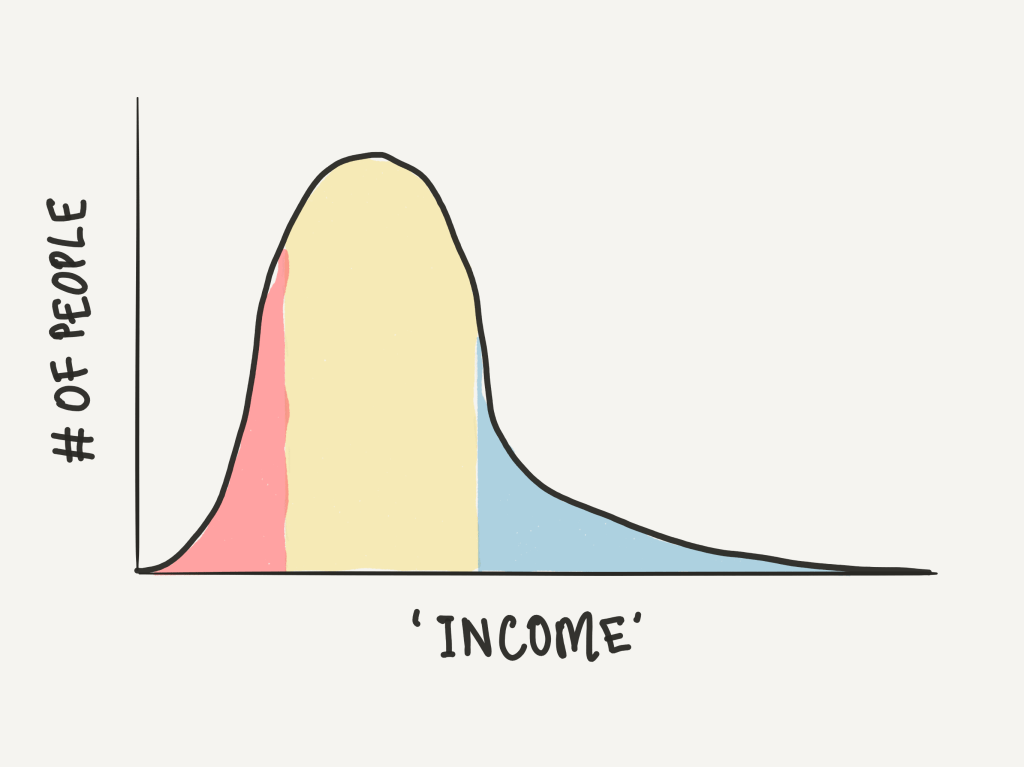
Let’s look at these two options in another way. The stylised graph below shows what a distribution of income looks like in many societies. The middle of the graph does not mean ‘middle class’ in the typical sense (i.e.: people earning a certain amount of money), it is the average. We’ll come back to this.

Ideas - 3

So, what do we have?

  • On the left are people who do not have a lot of income. (Red)
  • Towards the middle are most people in society (Yellow). This group of people earn the average income.
  • You have those with higher incomes still on the right. (Blue)

By definition, the average is a measure of central tendency, or the likeliest outcome. That jargony sentence simply means that if I had to pick the random person in Nigeria today, there is a good chance that his or her income will be near Nigeria’s average income. That is, he or she will fall into the Yellow portion. It also means that if you look out twenty years, the average Nigerian is likely to be earning the average Nigerian income, whatever that is by that time (the future Yellow). This is a consequence of what the average is.

Once you accept this, things become clearer. All you are concerned about is which average is likely to be better (option two). Do you want an average which allows you to pay tax, travel, enjoy 24-hr electricity and water and cheap high-quality education for the rest of your life? (High Income) Or do you want an average where you are worried about an emergency medical operation? (Low Income)

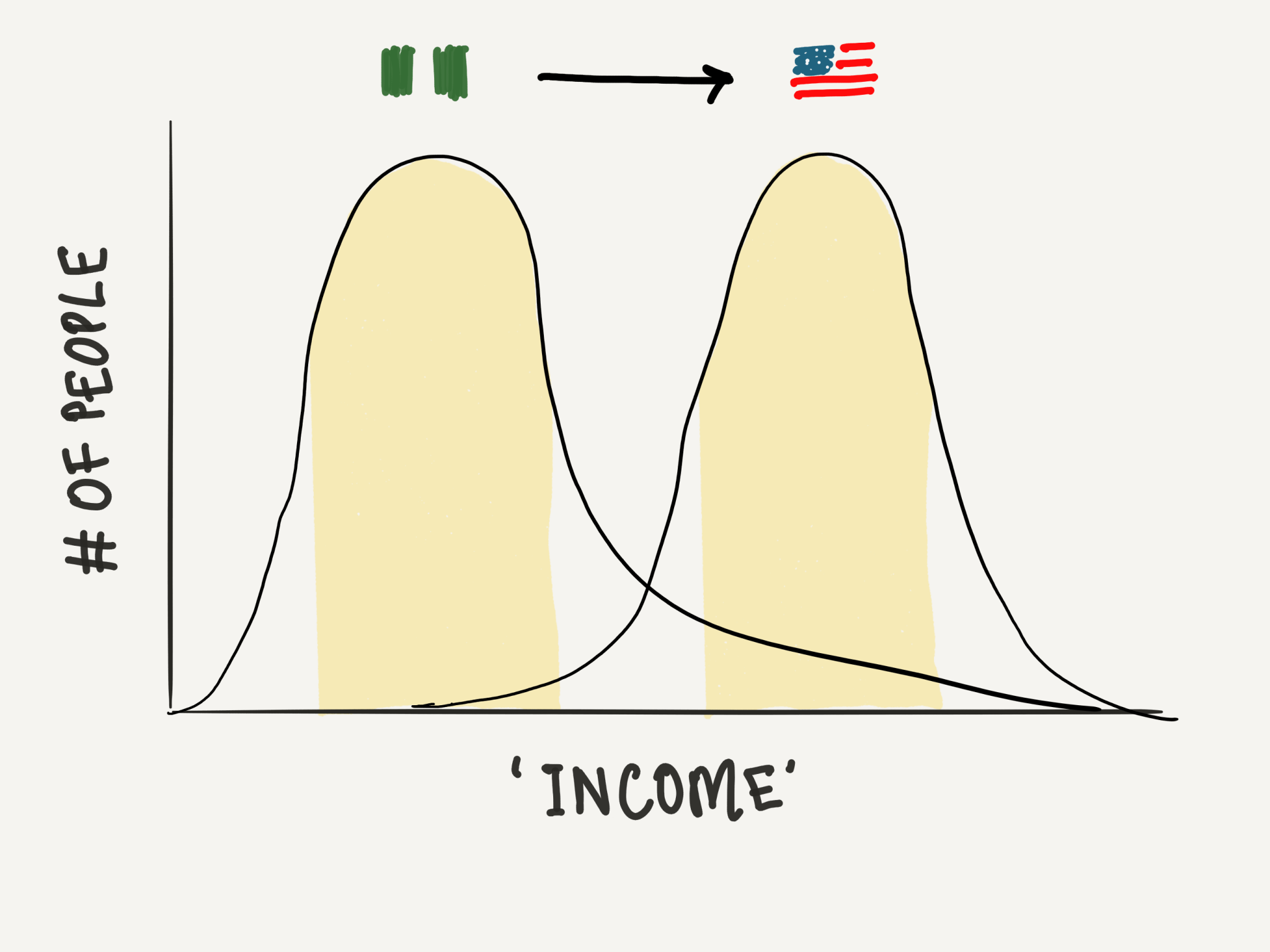
Going back to our graph of income distribution, here is what I mean by a choice between averages:

Ideas - 3

On the one hand, we have where we are now—Nigeria. Then there is the U.S. graph to the right of it (it could be any other developed economy). Notice that overall, their average is a higher level of ‘income.’ In other words, the average American is doing better.

And this is all there is to it: Emigrating is a chance at a better average. (Please note that the average is the likely state wherever you are. I am not making the fallacious argument that leaving Nigeria is a choice between having average income overseas and having exceptional wealth in Nigeria. That is nonsensical.)

But we have another problem, don’t we. In the same way that the strategy to blow is not a strategy for all Nigerians, emigrating cannot be either. We cannot all emigrate. So are we stuck? Not quite. Looked at individually, it seems to me that a person has a better shot at a great life in a better average than trying to work themselves out of their current average (which is a very difficult thing regardless of where you are). That’s an option for Tunde’s friend (and the one he’s taken) but not for all of us.

This is a stark truth. There is no easy way out for Nigerians collectively: We cannot all hammer and we cannot all emigrate. We have to fix the country. When we speak of improving Nigeria, what that means to me is moving the Nigerian graph to the right. It does not mean moving a few people from the Red to Blue portion of the existing graph. Economic development is simply a process of helping most of society ‘emigrate’ to a better life at home. It is not creating millionaires or billionaires. Our World In Data shows how this has worked over time. It shows that the world’s graph has progressively moved to the right; that on the whole, we are all better off now compared to a hundred years ago. We’ve moved the average, and that’s what Nigeria needs, a better average.


I should add a few thoughts which I was not able to incorporate into the body of the essay, but which are quite important nonetheless:

  1. Notice that I left the word ‘income’ in quotes; that was deliberate. It does not mean ‘money.’ It is things such as lower costs, expanded lifestyle options, better quality of life, freedom and so on. These all enhance our wellbeing but are non-monetary in nature. For instance, being able to walk into a public library that was founded by Benjamin Franklin in the 1700s is free. But, for people like me, it is a massive increase in my ‘income’ or my wellbeing. I also like trees. Being in a green space is free, but it enhances my ‘income.’ Stress may appear costless because there is no naira or kobo charge, but eventually, we will pay through some medical issue or the other. (This idea is a staple of economics) There are other non-monetary factors which enter into this conversation. Identity is important, and this could become an issue overseas. Xenophobia and racism are never far off. What of family? It is very difficult to leave one’s loved ones and emigrate, we deny ourselves the privilege of watching them (and they us) grow old. there is no money one could attach to that pain. In other words, there are many things which cannot be modelled in a spreadsheet which increase or decrease our wellbeing. A lot of us miss this when thinking about these decisions.
  2. To point out that most people will be in the average is not a predication for your life. In fact, I am hoping that I manage to escape the average myself. However, the disconcerting truth is that we must run as hard as we can to likely end up average. But what is life if not the ability to relish its complexities and contradictions?
  3. I am writing (and you may be reading) as someone who has had the advantage of privilege. The middle and below is an ugly place in Nigeria, most of our countrymen and countrywomen live a life of unimaginable hardship. Our concerns here are the privilege of the rich. This is not to criminalise wealth or to victimise the poor. It is an acknowledgement of the unfortunate status quo. The vast multitude of our people are more worried about a warm meal, a comfy bed, making it through this rainy season. If you have escaped this (by your effort or Fate’s design) be grateful, you have better problems.
  4. Apologies to the statisticians and/or economists who may object to some of the liberties I’ve taken. I deliberately tried to strip away most of technicalities associated with the curves and averages.
  5. @inpoco and @andyRoidO were generous with their time and helped me to bring this essay to life. I thank them. Obviously any errors or problems are mine alone.


Monday It Is

By the end of this post you might have established that I am bored, anxious to post something, or horribly foolish. You see, I do not know what to write (or, sometimes I wonder, how to). When I started this blog I had the idea that my life was quite interesting and that it offered something worth writing about. It turns out that my life is pedestrian and notably normal. It goes as follows: home, office, home, office (repeat), with long interruptions of heavy traffic in between. There is hardly anything to write about.

So I came up with an idea to fix this. (My blog, not my life) I am going to start recommending articles! Every Monday, I will post the best articles, posts, essays, YouTube videos, tweets, whatever, the best content I read or watched in the previous week. Yes, I know that this is not new, others have done it before. But they say ‘copying well is an act of defiance.’ Actually nobody said that, I just made it up. I figure since I read a lot and struggle to write, it may not be a bad idea to share that content each week. That way I am forced to take this blog and what I read a lot more seriously, I can actually start writing, and, hopefully, I can start driving some traffic through this thing. (Though why I care for any traffic here is quite beyond me.)

I have one criterion for what I share: The content has to be worth my time.

That’s it. The world is full of posts that are too long, rehashes of old ideas, or just forgettable fillers. My aim is to make sure everything I put up is worth it. This means I am going to have to comb the internet for content. That sounds easier than it is—the internet is bigger than most people can imagine. Also, I am a husband, dad, poor salary-collector and an amateur gamer. I have got a lot going on without a blog which needs me to commit to posting something weekly. I will try to get to five articles at the start of each week, but that is not a target. I’d rather inform you that I read nothing worth sharing (or that I am really too busy at the moment) than put up an article which does nothing for me. That said, you would have clicked through to my blog—a true act of Faith in our age—and so I think you ought to see something. I’ll try.

So, Monday, starting next week. Cheers.

With All Your Might

In Ben Horowitz’s The Hard Thing About Hard Things there is this now famous passage on putting in work:

I will never forget the first team meeting with head coach Chico Mendoza. Coach Mendoza was a tough old guy who had played college football at Texas Christian University, home of the mighty Horned Frogs. Coach Mendoza began his opening speech, “Some of you guys will come out here and you just won’t be serious. You’ll get here and start shooting the shit, talking shit, bullshittin’, not doing shit, and just want to look good in your football shit. If you do that, then you know what? Turn your shit in.” He went on to elaborate on what was unacceptable: “Come late to practice? Turn your shit in. Don’t want to hit? Turn your shit in. Walk on the grass? Turn your shit in. Call me Chico? Turn your shit in.”

It’s all good and well to do whatever it is that we do, but for the things which matter (and what matters is a deeply personal question), it is important to constantly ask ourselves the questions Coach Mendoza put to his team. Am I just ‘shooting the shit, talking shit, bullshittin’, not doing shit, and just trying to look good in [my] football shit?’ Or am I actually putting in the work. I think it is hard to deceive oneself for too long because the unconscious is simply too woke—It rebels against our conscious lies. But I suspect that it is quite possible to fool the world on this. To some degree that’s sort of what we have to do to get ahead, isn’t it. We embellish our qualifications, our experience, our network, our wealth, and so on. We receive, hopefully, some external validation in return, and this is comforting if temporary.

A more permanent satisfaction can be had from the personal knowledge that you’ve attacked your goals as completely as you could have. It does not come from the outcomes of this process, it is the natural consequence of this philosophy of living. Hard work is its own reward. It doesn’t matter if you put in twelve-hour days and still could not hit your target, you’ve hit your internal target. The sweet privilege of being able to say from the very core of your soul ‘I did my best’ is golden, and is a good deal more valuable that being told that you did well. Ralph Waldo Emerson shared this idea in his essay Self Reliance, when he said: ‘A man is relieved and gay when he has put his heart into his work and done his best, but what he has said or done otherwise, shall give him no peace.’ This relief is a wonderful thing next to the torment of knowing that you were just ‘bullshittin’, talking shit and not doing shit.’ We cannot externalise this validation. It cannot come from a performance rating for a bonus at your company, it cannot come from our boss or any other third party we look to for validation. This relief, this contentment, this peace, comes from putting in the work.

In the book of Ecclesiastes (9:10) it says: ‘Whatever your hand finds to do, do it with all your might.’ It is a call to work, to work hard, and to acquit ourselves before God.

Struggling To Write

Lately I’ve had the urge to write. But for me the baseline question when I write to publish always is—Do you have anything to say? It is easy enough to rehash an idea that has been expressed elsewhere in one of my scattered readings, but getting an original idea or a unique perspective or a new way of expressing an existing notion is a very difficult thing indeed. Quite often I think I have something to say and I feel strongly about it. I then proceed to try to express what I am thinking. And sure enough it reads like utter garbage. It is inauthentic, cosmetic, foogayzi and altogether embarrassing.

At other times, I simply do not have the words. This is an oddly familiar state of existence for people who write for a living. There is really nothing so annoying as having something to say and not knowing how to say it. It is rather like that mute state of idiocy many people enter into when they meet their crushes. This is where I am now and thankfully I do not write for a living.

That said, this process may serve a very important function. It may be a useful way of refining ideas, getting closer to the proverbial koko of the matter. Someone said somewhere that the essence of reading is rereading. Well, it seems to me that the essence of writing is quite possibly rewriting, and very often discarding completely.

So this is the screed I’ve managed to write today. I have twenty-two draft essays in different stages of construction but none of them feels right. Here I am trying too hard, there my thoughts are vague, confused and woolly. And yet, even though I know that none of this stuff can be published, I am too scared to delete them because, well, thinking up stuff is tough and usually a full thought is the filtration of several half-baked, wacky, confused ideas which have had time to age and mature in the casks of our brains. One minute you have absolutely nothing to say, the next it pours out in torrents.

Or not. Sometimes you just remain frustrated and incoherent. You cannot write. Here we are.

Leadership

One of the great fallacies in Nigeria is the notion that leadership starts and ends with political leadership, and that “our leaders” are the entire cause of the problem with Nigeria. This is a fine piece of nonsense. Leadership is a broad concept. The church is a constituency with leaders, so are the mosques, the traditional healers, the business establishment, academia, students, and so on. Every segment of our population has a hierarchy of some sort, and with that, it also has a leadership class. Our lazy habit of blaming all and sundry on our leaders, and especially our leaders in “government” (by which we usually mean the federal government, not, say, the judiciary, or the 36 imbeciles who lead the states) is a classic cop out. It is a way to make us feel better about ourselves. The fact of the matter is that wherever you are, as a member of our society, you have the opportunity to demonstrate the leadership you wish we had. And watching these alternate leaders in society is a study in the true challenges of leading the county. Too often we see the exact reflection of everything that we loudly complain about. The example of estate associations stands out. It is a real indictment that even in the entirely private, resident-controlled estate associations, whose job it is to ensure the comfort, security and general wellbeing of the residents of the estate they belong to, the record shows that, as a rule, these associations fail to discharge that responsibility honestly and diligently. The stories of mismanagement, simple theft and tribalism are legion. Perhaps even, the existence of these organisations is a statement set in bold of the critical challenge of achieving basic goals in this country. I am still flabbergasted by the daily reality of neighbours, whose children play together, stealing diesel money from the estate pot. The insults we hurl at “government” make us feel better about ourselves. We trot out the standard complaint that “we are not ready” all the time. Yet, in our small pockets, we fail miserably. Surely there is no greater demonstration of the national challenge than these micro failures. It is an uncomfortable truth, but Nigeria is made up of Nigerians, not anyone else. What we see is what we are. And we are, far more often than we wish to admit, not the change we wish to see in our world.

Posterized!

Check out the greatest posterizing dunks of all times:


OK. This video has no Shawn Kemp dunk, so I can’t really take it seriously. (For those of you who are too young, Shawn Kemp was a wild man who used to dunk so hard on people their bone marrow would squirt out of their nostrils.)

Still, this is some evil shit. But pause, let’s think about this for a second. When six-foot-five-ninety-kilograms of elite athlete has a run up, the best thing to do is get out of the way. 99 out of 100 times the ball is going in. Hard. All who get between said athlete and the rim will be posterized–it’s just physics really.

And it is beautiful to watch, it gets the crowd pumped, it gets the adrenaline going, it gets the bench involved, sends a message to the opponent, the TV guys love it, it is just what you need in a tough game.

And the attacking player gets his poster. But here is the thing. We never pause to think about the guy who gets up to contest the play. The fighting spirit, the will to not get beaten, to risk embarrassment (or even injury) to prevent the play or block the shot. He knows that 99 out of 100 times he’ll end up on the floor, but still he gets up to fight.

Far too often I see this and it bothers me. The defender was doing his job. He didn’t simply turn away or give up for fear of being your evening bants. He stuck in and got his ass handed to him. That’s part of the job.

I guess it’s all just a bit of harmless fun. But never forget that guy who did his job, risked being schooled, got schooled, got up and completed his duty. He did his job, got flattened, stood up, and continued.